
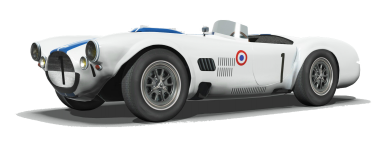
Overview
The Cunningham C4-R is part of LMC26 Grid1, the mid-1950s grid. It uses a Chrysler 331 Firepower V8, 5,425 cm³ (5.43 L).
History
The C-4R was built in 1952 as part of Briggs Cunningham's American sports-car racing programme. The C-4R family achieved some of the marque's strongest results, including third place overall at Le Mans. Simeone Foundation Automotive Museum
LMC specifications
Specifications for the current LMC configuration.
| Specification | Value |
|---|---|
| Mass (kg) | 1,195 kg, excluding fuel |
| Engine and displacement | Chrysler 331 Firepower V8, 5,425 cm³ (5.43 L) |
| Transmission and number of gears | Rear-wheel drive; 3 forward gears; ratios 2.393:1 / 1.530:1 / 1.000:1; optional 4-speed gearbox available |
| Fuel capacity (l) | 190 L maximum; 95 L default |
| Brakes | Drum brakes on all four wheels; default balance 54% front / 46% rear |
| Tyres | Default garage pressures: 180 kPa (1.80 bar) front and rear |
Driving advice
The car has rear-wheel drive and a default weight distribution of 56.5% front / 43.5% rear. The differential uses fixed 40% power-side and 30% coast-side locking, with 54.233 N·m preload. Default spring rates are 18.717 N/mm front and 18.561 N/mm rear. Individual gear ratios are fixed; the final drive can be changed in the garage.
There is no active engine rev limiter. Downshifts can drive the engine beyond its useful speed range. Brake balance is adjustable in the garage, but not while driving.
The vehicle upgrades offer a Cadillac 3-speed gearbox or a SIATA 4-speed gearbox. The 4-speed ratios are 2.920:1 / 1.825:1 / 1.292:1 / 1.000:1.
Braking
| Technology at Le Mans in 1954 | Representation in the current LMC physics |
|---|---|
| Large-diameter hydraulic drum brakes | Limited cooling, particularly at the rear. Nominal full-effectiveness temperature ranges are 300–500 °C front and 290–555 °C rear; repeated braking can push the brakes beyond these ranges and cause fade. |
Fade means a loss of braking effectiveness as the brakes overheat. These temperature ranges describe the simulation, not historical measurements. Brake balance is adjustable in the garage only.
Engine management and endurance
Engine speed and service life
The engine wear model has a reference life of 24 hours at 6,850 rpm and an oil temperature of 105 °C, with no random variation in its initial lifetime. This is a wear reference, not a recommended operating speed or a guaranteed race duration.
At a constant oil temperature, each additional 250 rpm doubles the rate of engine wear. At a constant engine speed, each additional 5.9 °C of oil temperature also doubles the wear rate. The two effects combine. Lower engine speeds and oil temperatures reduce wear relative to those reference conditions.
Fuel
The default fuel load is 95 L and the tank holds up to 190 L. Consumption in L/lap and stint duration have not yet been measured for this specification.
Baseline setup
| Setting | Default | Available adjustment |
|---|---|---|
| Fuel load | 95 L | Up to 190 L |
| Front tyre pressure | 180 kPa (1.80 bar) | 180–230 kPa (1.80–2.30 bar), in 10 kPa (0.10 bar) steps |
| Rear tyre pressure | 180 kPa (1.80 bar) | 180–230 kPa (1.80–2.30 bar), in 10 kPa (0.10 bar) steps |
| Brake balance | 54% front / 46% rear | 52–58% front, in 2 percentage-point steps |
| Brake pressure | 100% | 75–100%, in 5 percentage-point steps |
| Final-drive ratio | 3.36:1 | 3.54:1 / 3.36:1 |
These are the current default settings, rather than a circuit-specific race setup.
Pit stops
These are nominal stationary service times for the current LMC car, before variable crew delays. They exclude the drive through the pit lane and are not measured race time losses.
Without repairs
| Selected service | Nominal time |
|---|---|
| Refuelling only | Fuel added in L / 1.65 L/s + 2.5 s for connecting and disconnecting the hose |
| Refuelling only, adding 50 L | 32.8 s |
| Front or rear tyre pair only | 45 s |
| All four tyres only | 100 s (1 min 40 s) |
| Driver change only | 40 s |
| Tyre-pressure adjustment without replacing tyres | 5 s |
With repairs
| Repair work | Nominal work duration |
|---|---|
| Bodywork / aerodynamic damage | 30 s |
| Suspension damage, including detached wheels | 150 s |
Repairs are performed separately from other services and extend the stop. The repair model includes a random-delay allowance of 7.5 s. These are work durations, not complete stop totals; selecting bodywork and suspension repairs can require both operations. Damage also adds 4 s to a driver change.
Planning the stop
Request the stop at least 30 s before reaching the pit box. A late request can add up to 6 s of preparation delay. The crew stands down 150 s after a request if the car has not arrived.
Tyre changes are configured as separate work; refuelling and driver changes permit overlap with eligible services. Do not simply add every row to predict a combined stop. Refuelling, tyre changes, driver changes and damage repairs all have variable delays, so allow a margin and use the in-game pit estimate for the selected operations. Combined service times have not yet been measured in-game.
Specification notes
Specifications checked against the current LMC car on 11 September 2026. Mass excludes fuel. Tyre pressures are garage settings. Power and torque are omitted until figures for the current complete configuration are verified.