
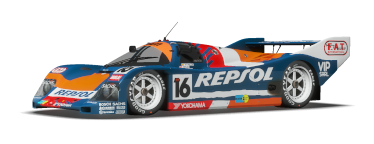
Overview
The Porsche 962C is part of LMC26 Grid5. It uses a Porsche WSC twin-turbo flat-six, 3.0 L. These figures describe the default LMC specification. This sheet covers the WSC engine used by the current entries; bodywork and tyre options depend on the selected entry.
History
The Porsche 962 C continued the marque's successful Group C programme. Derek Bell, Hans-Joachim Stuck and Al Holbert won Le Mans in a works 962 C in both 1986 and 1987. Porsche
LMC specifications
Specifications for the current LMC configuration.
| Specification | Value |
|---|---|
| Mass (kg) | 832 kg, excluding fuel |
| Engine and displacement | Porsche WSC twin-turbo flat-six, 3.0 L |
| Transmission and number of gears | Rear-wheel drive; 5 forward gears |
| Fuel capacity (l) | 100 L maximum; 75 L default |
| Brakes | Disc brakes; default balance 52% front / 48% rear |
| Tyres | Default garage pressures: 135 kPa front / 135 kPa rear |
Driving advice
Default weight distribution is 41.5% front / 58.5% rear. Brake balance can be adjusted while driving.
The default rev-limit setting is 8,200 rpm. The garage range is 8,000–8,300 rpm, in 100 rpm steps.
The vehicle options include different shifter control modes. Select the mode that matches your pedals and shifter; required throttle lift and clutch use depend on that selection.
Engine management and endurance
Engine life and temperature
The reference engine life is approximately 7.50 hours at 8,000 rpm and an oil temperature of 110 °C. There is no random variation in the initial lifetime. These conditions define the wear reference, not a recommended operating point or guaranteed race duration.
At constant oil temperature, each additional 150 rpm doubles the wear rate. At constant engine speed, each additional 2 °C of oil temperature doubles the wear rate. The effects combine; lower speeds and temperatures reduce wear relative to the reference conditions. Turbo operation also affects engine load; these reference values do not establish a guaranteed stint duration at every boost setting.
Fuel
The tank holds up to 100 L. The default load is 75 L. Consumption in L/lap and stint duration have not been measured for this specification.
Baseline setup
| Setting | Default | Available adjustment |
|---|---|---|
| Fuel load | 75 L | Up to 100 L |
| Front tyre pressure | 135 kPa (1.35 bar) | 135–190 kPa, in 1 kPa steps |
| Rear tyre pressure | 135 kPa (1.35 bar) | 135–190 kPa, in 1 kPa steps |
| Brake balance | 52% front / 48% rear | 40–75% front, in 1 percentage-point steps |
| Brake pressure | 100% | 85–100%, in 1 percentage-point steps |
| Rev-limit setting | 8,200 rpm | 8,000–8,300 rpm, in 100 rpm steps |
These are default garage settings and available ranges, not a circuit-specific race setup.
Pit stops
These are nominal stationary service times for the current LMC car, before variable crew delays. They exclude the drive through the pit lane and are not measured race time losses.
Without repairs
| Selected service | Nominal time |
|---|---|
| Refuelling only | Fuel added in L / 2.0 L/s + 1.9 s for connecting and disconnecting the hose |
| Refuelling only, adding 50 L | 26.9 s |
| All four tyres only | 16 s |
| Driver change only | 11 s |
The tyre service is a complete set of four; separate front or rear pair changes are not offered.
With repairs
| Repair work | Nominal work duration |
|---|---|
| Bodywork / aerodynamic damage | 15 s |
| Suspension damage, including detached wheels | 90 s |
Repairs are performed separately from other services and extend the stop. The repair model includes a random-delay allowance of 2.5 s. These are work durations, not complete stop totals; selecting bodywork and suspension repairs can require both operations. Damage also adds 1 s to a driver change.
Planning the stop
Request the stop at least 25 s before reaching the pit box. A late request can add up to 6 s of preparation delay. The crew stands down 240 s after a request if the car has not arrived.
Tyre changes are configured as separate work; refuelling and driver changes permit overlap with eligible services. Do not simply add every row to predict a combined stop. Refuelling, tyre changes, driver changes and damage repairs all have variable delays, so allow a margin and use the in-game pit estimate for the selected operations. Combined service times have not yet been measured in-game.
Specification notes
Specifications checked against the current local LMC car on 11 September 2026. Mass excludes fuel. Tyre pressures are garage settings. Power and torque are omitted until figures for the current complete configuration are verified.