
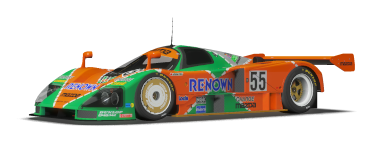
Overview
The Mazda 787B is part of LMC26 Grid5. It uses a Mazda R26B four-rotor engine, 2.6 L nominal displacement. These figures describe the default LMC specification. Tyre options depend on the selected entry.
LMC specifications
These values describe the mod physics and may differ from the historical car.
| Specification | Value |
|---|---|
| Mass (kg) | 830 kg, excluding fuel |
| Engine and displacement | Mazda R26B four-rotor engine, 2.6 L nominal displacement |
| Peak power (PS) and engine speed (rpm) | 711.2 PS at approximately 9,000 rpm (reference curve; before LMC performance adjustments) |
| Peak torque (Nm) and engine speed (rpm) | 608 Nm at approximately 6,500 rpm (reference curve; before LMC performance adjustments) |
| Power-to-weight ratio (PS/t) | 856.8 PS/t (reference curve; excluding fuel) |
| Transmission and number of gears | Rear-wheel drive; 5 forward gears |
| Fuel capacity (l) | 115 L maximum; 115 L default |
| Brakes | Disc brakes; default balance 52% front / 48% rear |
| Tyres | Default garage pressures: 135 kPa front / 135 kPa rear |
Driving advice
Default weight distribution is 42% front / 58% rear. Brake balance can be adjusted while driving.
The default rev-limit setting is 9,000 rpm. The garage range is 8,500–9,100 rpm, in 100 rpm steps.
The vehicle options include different shifter control modes. Select the mode that matches your pedals and shifter; required throttle lift and clutch use depend on that selection.
Engine management and endurance
Engine life and temperature
The reference engine life is approximately 8.33 hours at 9,000 rpm and an oil temperature of 100 °C. There is no random variation in the initial lifetime. These conditions define the wear reference, not a recommended operating point or guaranteed race duration.
At constant oil temperature, each additional 100 rpm doubles the wear rate. At constant engine speed, each additional 5 °C of oil temperature doubles the wear rate. The effects combine; lower speeds and temperatures reduce wear relative to the reference conditions.
Fuel
The tank holds up to 115 L. The default load is 115 L. Consumption in L/lap and stint duration have not been measured for this specification.
Baseline setup
| Setting | Default | Available adjustment |
|---|---|---|
| Fuel load | 115 L | Up to 115 L |
| Front tyre pressure | 135 kPa (1.35 bar) | 135–190 kPa, in 1 kPa steps |
| Rear tyre pressure | 135 kPa (1.35 bar) | 135–190 kPa, in 1 kPa steps |
| Brake balance | 52% front / 48% rear | 40–75% front, in 1 percentage-point steps |
| Brake pressure | 100% | 85–100%, in 1 percentage-point steps |
| Rev-limit setting | 9,000 rpm | 8,500–9,100 rpm, in 100 rpm steps |
These are default garage settings and available ranges, not a circuit-specific race setup.
Specification notes
Specifications checked against the current local LMC car on 11 September 2026. Mass excludes fuel. Tyre pressures are garage settings. Power, torque and power-to-weight describe the reference engine curve before LMC performance adjustments and transmission losses. They are not measured wheel output. Power uses metric horsepower (PS).